
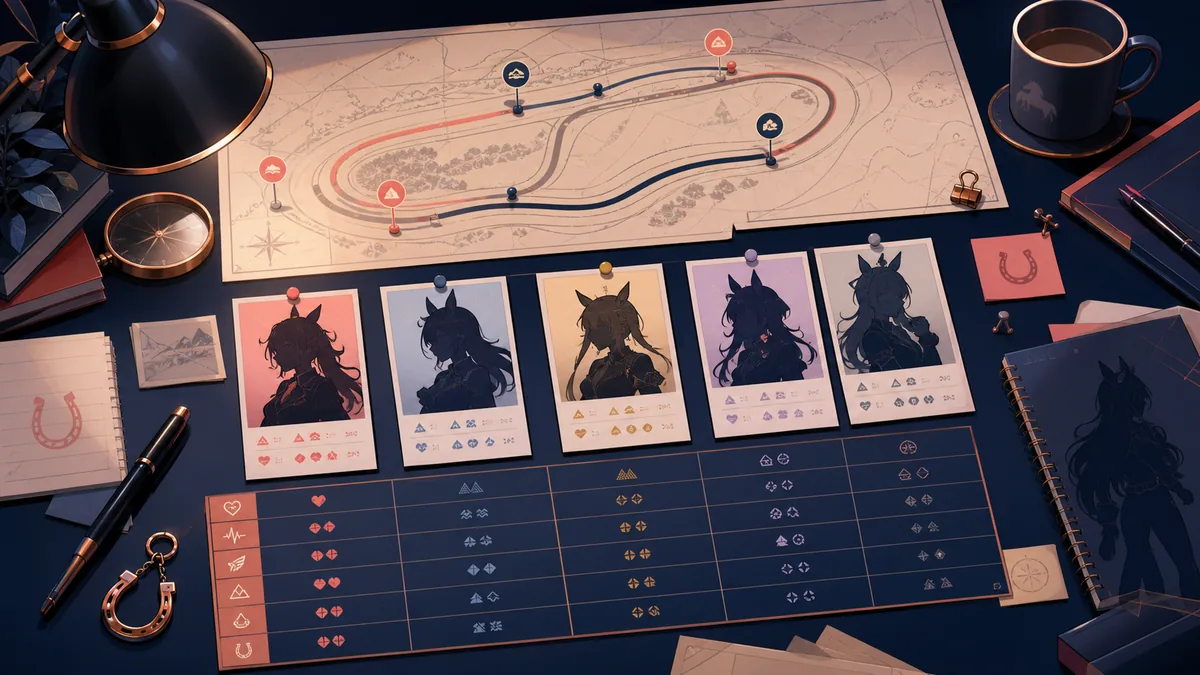
How to Read an Umamusume Character Tier List
An Umamusume tier list is useful when it helps you narrow the first decision: which trainee is worth building for the race you care about. It becomes risky when you treat it as a universal answer. A character that dominates one Champions Meeting condition can be ordinary in another race because distance, surface, running style, and unique skill timing change the value of the kit.
Start by separating character tier lists from support card tier lists. A character ranking asks which trainee can convert a race plan into a strong final runner. A support card ranking asks which training resources help you build that runner. Those pages should inform each other, but they do not answer the same question.
For Global players, also check whether a ranking was written for the current Global pool, the JP pool, or a future-looking meta. A JP-only character, scenario, or support card assumption can make a list accurate for one server and misleading for another.
If you searched for an Umamusume character tier list or the best Umamusume characters, start with the same boundary: rank the trainee for a race condition, not for a universal scoreboard. A character's tier is the fit between the kit and the course.
An Umamusume Pretty Derby tier list should state whether it covers Global, JP, current content, or future content. Treat a uma musume tier list as a shortlist, then check support cards, inheritance, and simulator results before spending resources.
Use tier lists as a shortlist
Before choosing a trainee, write down the race distance, surface, running style, key unique skill timing, inheritance gap, and support deck weakness. If the tier list does not help with those details, it is only a broad popularity signal.
What Actually Makes a Character High Tier
Most strong trainees have more than one advantage. Use these factors to understand why a character appears high or low in an Umamusume character ranking.
| Factor | Why it matters | How to check it |
|---|---|---|
| Distance and surface aptitude | Aptitude decides whether the runner can realistically reach the target race profile without wasting inheritance slots. | Check the target course first, then decide which red factors are still needed. |
| Running style fit | Runner, leader, betweener, and chaser builds need different positioning, acceleration, stamina, and skill timing. | Compare the character's best style with the race phase where the winning move usually happens. |
| Unique skill timing | A famous unique skill can still be weak if it activates too early, too late, or under conditions the race does not support. | Read activation conditions and test finished stats instead of judging by name alone. |
| Growth bonuses | Growth bonuses change which support cards feel efficient and which stats are painful to finish. | Match growth bonuses with your owned support deck and borrow slot. |
| Inheritance pressure | Some characters need specific red factors, parents, or inherited skills before they become practical. | Check whether your parent pool can solve the missing distance, surface, or skill need. |
| Account and server context | A top JP recommendation may depend on cards, scenarios, or characters not yet available to every Global account. | Confirm the ranking's server, date, and assumptions before copying it. |
The best character for your account is often the one with the fewest unsolved requirements, not the one with the highest generic tier label.
Best Character Fit by Race Distance and Role
Distance is the easiest way to make a tier list practical. Use the table as a decision frame before comparing names from a ranking page.

| Race focus | Character traits to prefer | Support deck pressure | Validation check |
|---|---|---|---|
| Sprint | Fast acceleration, clean speed growth, and reliable short-race skill timing. | Speed, Power, and Wit pressure can be high because there is little time to recover from bad positioning. | Confirm the build reaches final speed quickly and does not rely on late skills that trigger after the race is decided. |
| Mile | Flexible speed, Power, and positioning tools with a running style that fits the course. | Decks often need enough Wit for consistency while still finishing Speed and Power. | Simulate several variants because small skill-timing differences can change win rate sharply. |
| Medium | Balanced kits, useful unique timing, and enough stamina or recovery access. | The deck must avoid overbuilding one stat while leaving stamina, Power, or Wit exposed. | Run stamina and race simulation checks before assuming a high-Speed build is safe. |
| Long | Strong stamina plan, recovery access, and unique skills that still matter late in the race. | Stamina supports, recovery hints, and inheritance planning matter more than raw tier label. | Check stamina margin first, then compare finishing position and late acceleration. |
| Parent farming | Easy training routes, useful factors, and repeatable race schedules. | Consistency, event stability, and race bonus can matter more than peak PvP performance. | Use a planner to keep factor targets, race goals, and training turns aligned. |
Match a Tier Pick to Your Support Cards and Parents
A character tier list assumes the runner can actually be built. Your account decides whether that assumption is true. If the character needs a specific support deck, rare inherited skill, or distance upgrade that you cannot provide, the practical tier drops for your account until those pieces improve.
Support cards are the most common constraint. A trainee with excellent growth bonuses can still disappoint if your deck cannot provide the required skill family or stamina floor. The reverse is also true: a character that looks mid-tier on a generic list may be very strong for you because your parents and supports already solve the usual weaknesses.
When two characters look close, choose the one with the cleaner build path. Fewer forced inheritance fixes, fewer must-borrow cards, and easier stamina margins usually beat a slightly higher theoretical ceiling.
Owned support fit
Can your deck finish the needed stats without borrowing every missing role?
Parent pool fit
Do your parents solve distance, surface, unique skill, or factor pressure?
Scenario fit
Does the current training scenario reward the stats and events this character needs?
Testing fit
Can the finished build pass stamina and race simulation instead of only looking good on paper?
A Practical Workflow to Validate a Tier List Pick
Use this loop whenever a tier list gives you several possible characters for the same event.

Choose the race target
Record distance, surface, running style, weather or track assumptions, and the win condition you are building around.
Shortlist characters
Pick only characters whose aptitude and unique skill timing plausibly match that target.
Check inheritance pressure
Mark which red factors, parent uniques, and stat factors are required before the build is realistic.
Map the support deck
Use your owned cards and borrow slot to cover stat growth, skill access, recovery, and consistency.
Train and simulate
After the run, test stamina and race outcomes. Change one variable at a time instead of blaming the whole tier list.
Common Tier List Mistakes
Most poor character choices come from reading the ranking without the surrounding assumptions.
- Copying a JP list for a Global-only box. Future characters, scenarios, and cards can change the ranking. Use JP lists for planning, not as an exact Global build recipe.
- Ignoring distance and surface. A character can be high tier overall but still need too many inheritance fixes for the race you selected.
- Treating support card strength as character strength. A strong deck can make many trainees work. A weak or mismatched deck can make a top trainee underperform.
- Skipping stamina validation. Medium and long races often punish builds that look good by Speed alone. Check stamina and recovery before trusting the result.
- Changing too many variables at once. If a simulation result is bad, compare one change at a time: parent pair, support deck, recovery, running style, or skill package.
Use Character Rankings with Race Tools
The strongest use of a tier list is not choosing one name and stopping. It is choosing a testable hypothesis: this character should work for this race because the distance, running style, support deck, inheritance, and stamina plan all fit together.
After training, use tools to find the weak link. If the build fails, the fix might be a stamina recovery skill, a different parent, a support card swap, or a different strategy. The character tier label only tells you where to start.
Use the companion support card tier list and skill tier list as separate resources: they answer which training cards or skills support a character, not which trainee owns the race plan. If you want to arrange your own rankings, use the Tier List Maker instead of forcing that functional intent into this guide.
Useful internal resources for this workflow: Support Card Tier List Guide, Inheritance Guide, Stamina Calculator, Uma Race Planner, Training Simulator Guide; Tier List Maker.
Sources and Reference Links
These references support the guide's official context and help verify character, support, and game-system details before you commit resources.
- Umamusume Pretty Derby official site - Official game and character context from the franchise.
- Umamusume Pretty Derby on Steam - Official PC store listing and Global player context.
- GameTora Umamusume database - Community database for checking characters, skills, supports, and event details.
FAQ
What is the best character in Umamusume?
There is no single best character for every race. The best pick depends on distance, surface, running style, unique skill timing, inheritance, support cards, and the race condition you are preparing.
How do I use an Umamusume character tier list?
Start with the target race, then filter the best characters by distance aptitude, running style, unique skill timing, inheritance needs, and support deck fit. A tier label is a shortlist, not a guaranteed result.
Is an Umamusume tier list useful for Global players?
Yes, if you check the server and date. A Global player should treat JP-focused rankings as future planning unless the required characters, cards, and scenarios are already available.
Should I use a character tier list or a support card tier list first?
Start with the race target and character fit, then use a support card tier list to build that character. If your support deck cannot support the pick, choose a character with a cleaner path for your account.
Do lower-tier characters ever win?
Yes. A lower-ranked character with the right parents, support deck, skills, and stamina margin can outperform a higher-ranked character built for the wrong race.
How often should I re-check tier lists?
Re-check after major character releases, support card releases, new training scenarios, balance updates, or event conditions that change distance and skill priorities.
Can race simulation replace a tier list?
No. Tier lists help you shortlist candidates before training, while simulation checks whether the finished build works. Use both for better decisions.