Umamusume Team Trials Guide: Team Setup, Scores, and Promotion
Build a complete roster for Sprint, Mile, Medium, Long, and Dirt races, then use controlled testing to improve score instead of chasing one lucky win.


Quick answer: The strongest Team Trials plan is a complete five-category roster with a clear distance and surface job for every runner. Start with the categories where your account already has reliable aptitude and skills, then improve score by raising consistent placement, useful skill activation, and matchup coverage. A high rating or one impressive win is not enough by itself; compare the actual race results and promotion risk over several runs.
What Is Team Trials Really Testing?
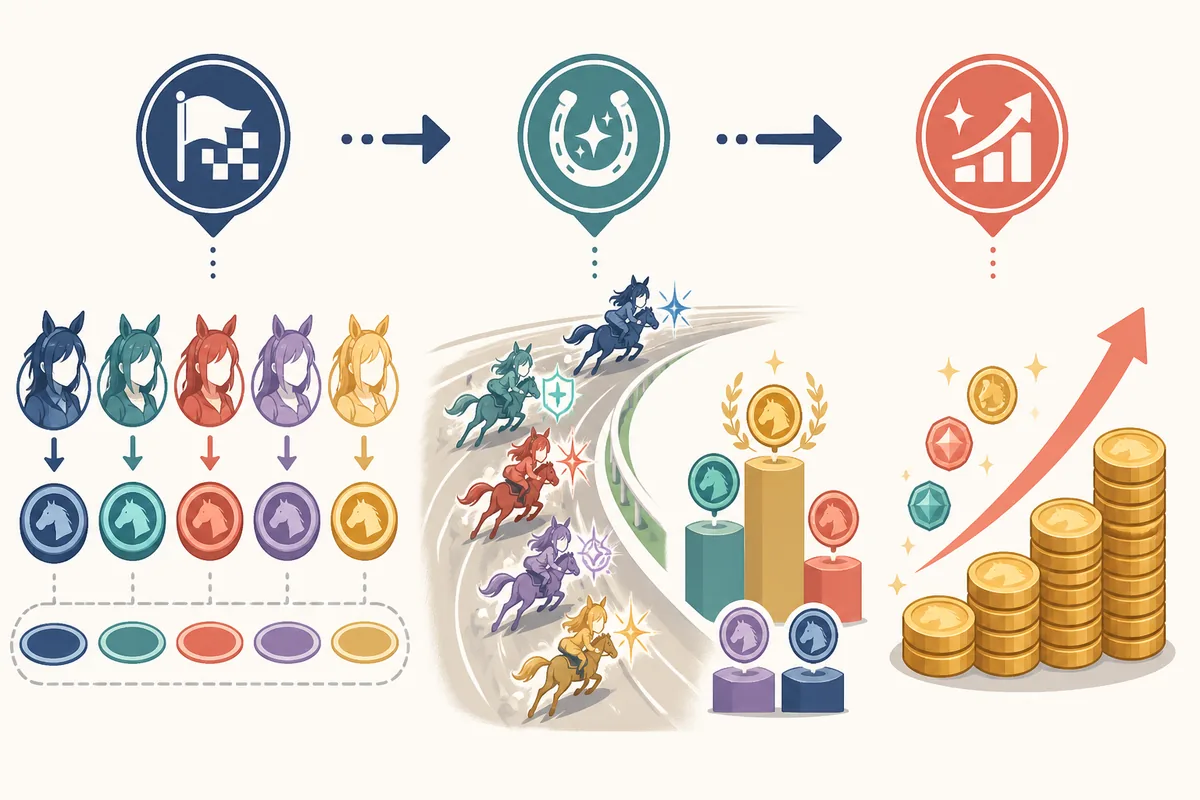
Team Trials is not one single race with one best build. It is a repeated test of how well your roster covers several race categories and how reliably those runners convert their stats, aptitudes, skills, and strategy into points. That changes the planning question from “Which Uma is strongest?” to “Which three runners give this category the most repeatable value?”
A good Team Trials guide therefore starts with coverage. You want an answer for Sprint, Mile, Medium, Long, and Dirt before you spend all of your resources on one polished runner. The exact opponents, skill pool, balance, and scoring details can change with game updates, so treat the categories and your recorded results as the stable planning layer and verify live thresholds in game.
The goal is not to force every runner into the same rating target. A runner with a lower visible rating can still be valuable if the build has the right aptitude, a coherent strategy, reliable skills, and a job your roster otherwise cannot fill. Conversely, a high rating can be inefficient when it is built around skills that never matter in the selected races.
Coverage first
Fill the five race categories before polishing a duplicate runner for a category you already cover well.
Consistency beats screenshots
Use several runs and inspect placement, activation, and score patterns instead of trusting one lucky victory.
Build for the actual job
Distance, surface, strategy, aptitude, stamina margin, and skill timing matter more than a generic tier label.
The Five Team Trials Race Categories
Your first roster pass should assign each runner to a category and a role. Sprint and Mile usually reward speed, power, acceleration timing, and a stamina budget that matches the course. Medium and Long ask for a more careful balance between speed, remaining HP, guts, recovery reliability, and late-race skills. Dirt is not simply a shorter Turf build: Dirt aptitude and the specific distance are separate checks that can invalidate an otherwise attractive stat line.
Do not copy a character tier list directly into Team Trials. A ranking can help you shortlist candidates, but the account's available support cards, inheritance, limit breaks, skill access, and aptitudes decide whether that candidate is actually a good fit. If two runners are close, prefer the one that fills a missing category or can be rebuilt with fewer risky assumptions.
| Category | What to check first | Useful planning question |
|---|---|---|
| Sprint | Short-distance aptitude, speed, power, acceleration timing, and enough stamina for the course | Can this runner reach the finish quickly without wasting skill points on irrelevant effects? |
| Mile | Speed and power balance, strategy fit, acceleration, and course-specific stamina | Does the build keep pace while preserving a reliable late-race option? |
| Medium | Speed, power, stamina margin, recovery timing, and position control | Is the runner stable across normal conditions instead of passing only one ideal setup? |
| Long | Stamina, guts, recovery reliability, and full-spurt testing | Can the runner finish and still execute the intended late-race plan? |
| Dirt | Dirt aptitude, distance aptitude, strategy, and the account's available skill package | Am I solving the Dirt slot first, rather than forcing a Turf build into it? |
How Team Trials Score Differs From a Win
A win is useful evidence, but it is not the whole Team Trials score. Competitive community guides commonly separate finishing results from the extra value created by skill activation, runner placement, matchup conditions, and other scoring details. The practical lesson is simple: record the final points and the race story, not just the word “win.” A runner that wins narrowly with no useful activation may be less valuable than a runner that places consistently and produces a stronger scoring pattern.
When you compare two builds, keep the category, opponents, strategy, support assumptions, and sample size as consistent as possible. Change one major variable at a time: a better acceleration skill, a more reliable recovery, a different distance aptitude, or a different runner role. This is the same reason a race simulator is useful here: it can organize the comparison, but the final decision still needs the live mode's own results.
Placement
Repeated high placements reduce the risk that one bad race wipes out the value of the slot.
Activation
Skills should have a realistic chance to trigger in the intended distance, strategy, and race phase.
Matchup
A category build should survive the common opponents and conditions you actually meet, not only a friendly test.
How to Build a Team Trials Runner
Start with the race, not with the character. Choose the category, surface, distance, and strategy you want to cover; then choose a runner whose aptitude and growth pattern make that job realistic. This prevents a common mistake where a favorite character receives a beautiful general build but still enters the wrong category with a weak aptitude or a skill package that cannot activate consistently.
Next, define a minimum viable version of the build. It should have the correct aptitudes, a survivable stamina plan, one or two reliable race-phase tools, and a realistic support-card route. Only after that baseline works should you spend extra skill points on marginal improvements. For Long and difficult Medium races, test the late-race plan rather than assuming a large stamina number automatically produces a strong finish.
Finally, compare the runner with the rest of the roster. If another category is weak, the marginal value of filling it may be higher than polishing an already safe slot. Team Trials rewards account-level coverage, so the best individual build is not always the best next build for the whole team.
- 1. Lock the category and conditions. Write down surface, distance, likely strategy, and the reason this slot matters to your roster.
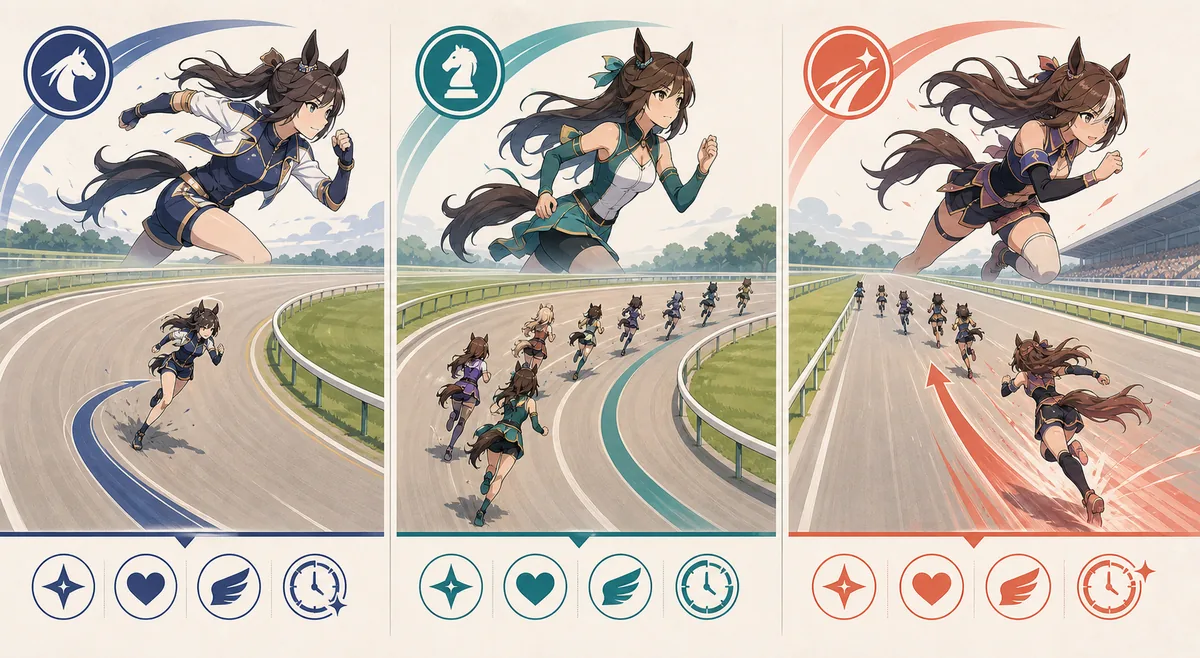
- 2. Check aptitude before stats. A strong stat total cannot fully rescue the wrong distance, surface, or strategy aptitude.
- 3. Build a repeatable baseline. Use the support cards, inheritance, skills, and training route you can actually reproduce on the account.
- 4. Test the late-race plan. For Medium and Long especially, verify stamina, recovery timing, guts, and full-spurt behavior under realistic conditions.
- 5. Compare the roster opportunity cost. If the next improvement only makes a strong slot slightly better, consider using those resources to repair an uncovered category.
- 6. Record live results. Log placement, score, activated skills, and the conditions so a promotion decision is based on a pattern rather than memory.
For supporting decisions, use the Umamusume Training Guide, Character Tier List Guide, Skill Tier List Guide, Rating Calculator, Stamina Calculator as references, not as substitutes for checking the category and conditions in Team Trials.
How to Review Promotion and Weekly Risk
Promotion decisions should use a short review loop. First identify the category that is losing the most points or producing the most unstable results. Then separate a build problem from a matchup problem: a runner may have the right stats but poor aptitude, a strong skill package that fails to trigger, or a role that clashes with the other runners in the same category.
Do not rebuild all five slots after one bad session. Keep the three best-supported categories stable, choose one experiment, and compare it against the saved baseline. When the same failure repeats, fix the narrow cause: distance or Dirt aptitude, stamina margin, acceleration timing, skill reliability, or a role conflict. This keeps promotion attempts from turning into an expensive account-wide reset.
Because thresholds and scoring can change, treat the following table as a review framework rather than a promise about a permanent rank line. The game screen is the final authority for the current promotion or retention requirement.
| Review signal | Likely interpretation | Next action |
|---|---|---|
| One category repeatedly loses | The slot has a clear coverage or build problem | Audit aptitude, strategy, stamina, and skill timing for that category first |
| Wins happen but score stays weak | Placement or scoring-relevant activation is inconsistent | Record race sequence and compare a more reliable skill package |
| All categories swing wildly | The sample is too small or conditions are not comparable | Save a baseline and collect a larger, consistent set of runs |
| Rating is high but results are poor | The build may spend points on skills or stats that do not fit the job | Rebuild around the actual distance, surface, strategy, and roster need |
| Promotion is close | Small reliability gains may matter more than a full rebuild | Test one affordable change and keep the rest of the roster stable |
Common Umamusume Team Trials Mistakes
Most weak Team Trials results are not caused by a single missing tier-list character. They come from a mismatch between the category, the build assumptions, and the way results are being judged.
Building only the favorite category
A polished Sprint or Mile runner cannot compensate for an empty Dirt or Long slot. Repair coverage before chasing small upgrades.
Treating a tier list as a finished roster
Tier lists are shortlists. They do not know your inheritance, support cards, limit breaks, aptitudes, or the role already taken by another runner.
Confusing rating with score
Rating can help compare builds, but it does not guarantee useful placement, skill activation, or the right race coverage.
Copying Turf into Dirt
Dirt aptitude and the selected distance deserve their own audit. A strong Turf stat line is not proof that the Dirt slot is solved.
Changing five variables at once
If stats, skills, strategy, support cards, and runner role all change together, the next result cannot teach you what actually helped.
Testing from one lucky run
A single victory is a useful anecdote, not a stable estimate. Keep a small log of placement, score, activation, and conditions.
Umamusume Team Trials FAQ
What is the best Team Trials team?
There is no permanent best team for every account. The right team covers the five race categories with runners whose aptitude, strategy, skills, stamina plan, and support-card route are realistic for you. Start with coverage and repeatable results, then improve the weakest slot.
Should I follow an Umamusume Team Trials tier list?
Use a tier list as a shortlist, not as an automatic team builder. Check the character's distance and Dirt aptitude, available inheritance, support cards, skill access, and role overlap before committing resources.
Does Team Trials rating matter more than winning?
Rating is only one diagnostic. A Team Trials build also needs reliable placement, useful skill activation, correct race coverage, and results that hold across several runs. Compare score and race patterns rather than using rating as the final verdict.
How do I build a low-rating character for Team Trials?
First confirm why you need a low-rating build and what score or matchup it is meant to serve. Keep the correct aptitude, strategy, and essential skills, then avoid unnecessary rating from skills that do not help the selected category. Test the result in the live mode instead of assuming lower rating automatically means easier wins.
Does formation matter in Team Trials?
Formation and role overlap can matter because multiple runners compete under the same category conditions. Treat the three runners as a small team: avoid giving every slot the same job, and test whether one pace setter, one control option, or one late runner produces more reliable placements.
How often should I rebuild my Team Trials roster?
Rebuild when a repeated pattern shows a real coverage gap, a patch changes the scoring environment, or a new account resource creates a clearly better route. Do not reset all five categories after one unlucky session; change the narrowest weak slot first.
A Practical Team Trials Decision Rule
When deciding what to train next, choose the category with the largest combination of coverage gap, realistic improvement path, and score upside. Build a reproducible baseline, verify aptitude and race conditions, and then test one change at a time. If the change improves both placement and score across several runs, keep it; if it only raises visible rating, treat it as unproven.
The best Team Trials roster is not a universal tier list. It is a five-category plan that fits your account, keeps the important skills active, and gives you a repeatable way to diagnose the next weak slot. Use the simulator and calculators to narrow decisions, then let the live Team Trials results decide whether the build is ready.
Sources and Method Notes
The structure follows current community explanations of Team Trials categories, scoring, and roster planning. Exact scoring details and promotion thresholds can change with game updates, so verify the live in-game screen before treating a number as permanent.
- uma.guide Team Trials guide — community overview of Team Trials categories and roster planning
- uma.guide beginner Team Trials guide — beginner-oriented explanations of team setup and practical checks
- GameTora Team Trials scoring guide — community documentation of scoring factors and race-result interpretation