

What an Umamusume Skill Tier List Really Means
An Umamusume skill tier list compresses a difficult decision into a simple label, but the label only matters when the race context is clear. Skills do not win in isolation. They win when the activation condition, race phase, running style, stamina margin, and final stat profile all support the same plan.
This is why one player can call an acceleration skill mandatory while another player barely notices it. The first player may be testing a course where the skill fires at the final corner or final straight exactly when the runner can overtake. The second player may be using the same skill on a course where it triggers too early, triggers too late, or never meets the condition.
Read skill rankings as a decision map. The tier tells you which skills deserve attention first, then your race plan decides whether the skill actually belongs in the build.
Rank the job before the name
Before buying or inheriting a skill, identify its job: acceleration, recovery, speed extension, positioning, lane movement, start consistency, or course-specific coverage. A famous skill used for the wrong job is still a poor investment.
What Actually Changes a Skill's Tier
A skill rises or falls based on how reliably it contributes to the race you are preparing. Use these factors before treating any tier label as final.
| Factor | Why it matters | How to check it |
|---|---|---|
| Activation timing | A skill must trigger during a phase where its effect can still change the result. | Compare the condition with the course layout, final corner, final straight, and running style. |
| Effect type | Acceleration, speed, recovery, and positioning solve different problems. | Ask whether the runner needs a win condition, stamina safety, or consistency improvement. |
| Distance fit | Short, mile, medium, and long races reward different skill mixes. | Check whether the skill has enough time to matter and whether stamina pressure changes the priority. |
| Running style fit | Runner, leader, betweener, and chaser skills often depend on position or pack behavior. | Confirm the skill condition matches where that style normally sits during the race. |
| Cost and opportunity cost | A strong skill can be a bad buy if it prevents two cheaper skills that solve more urgent problems. | Compare skill point cost against missing recovery, acceleration, or consistency coverage. |
| Inheritance and support access | Some skills are easy to acquire only through parents or specific support cards. | Plan the source before training so the build does not rely on luck at the end. |
A tier list that does not mention timing, distance, style, and source should be treated as a broad popularity list, not a complete build plan.
Skill Priorities by Distance and Running Style
Distance and style turn a generic skill ranking into an actionable shortlist. Start with the target race, then choose the skill category that fixes the most important failure point.
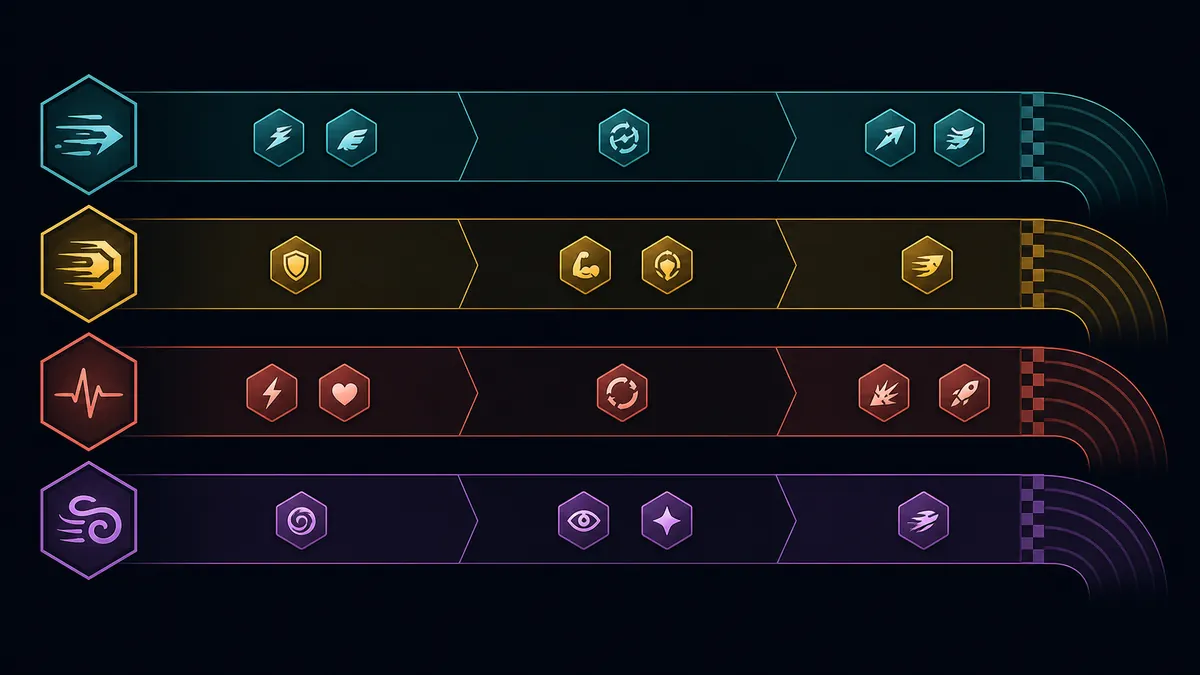
| Race plan | High-priority skill jobs | Common trap | Validation check |
|---|---|---|---|
| Sprint / Mile runner | Start consistency, early positioning, and well-timed acceleration that protects the lead. | Buying late skills that activate after the race is already decided. | Simulate whether the runner keeps position through the final corner and final straight. |
| Mile / Medium leader | Balanced acceleration, speed extension, and enough recovery or stamina buffer for the course. | Overstacking generic speed while ignoring the skill that creates the winning move. | Compare one acceleration swap at a time instead of changing the whole build. |
| Medium betweener | Final corner or late-race acceleration plus positioning tools that prevent being blocked. | Choosing a high-tier skill whose position condition rarely matches the runner. | Check replay/log behavior or simulation outcomes for late move consistency. |
| Long chaser | Recovery first when stamina is tight, then late acceleration and speed finishers. | Copying a short-race damage package without enough stamina margin. | Run a stamina calculation before judging damage or speed skills. |
| Parent farming | Consistent race completion, useful inheritable skills, and repeatable schedule support. | Buying peak PvP skills that do not improve the factor farming loop. | Use a planner to keep race schedule, parent goals, and training turns aligned. |
How to Choose Skill Priority Before Spending Points
Skill points are limited, so the order matters. Start with skills that make the build function, then add efficiency and consistency. A common mistake is buying every recognizable gold skill while leaving the actual race plan unfinished.
A simple priority stack works for most builds: first meet stamina and recovery needs, then secure the acceleration or unique timing that creates the winning move, then add speed extension and positioning, then use leftover points on cheap consistency skills. The exact order changes by course, but the logic stays the same.
When two skills look close, prefer the one with clearer activation and a job that your build does not already cover. Redundant skills can still help, but only after the main failure point is solved.
Must-have skills
Skills that make the race plan work, such as required recovery for long races or a course-matching acceleration trigger.
High-value skills
Efficient speed, positioning, or secondary acceleration that improves win rate after the core condition is covered.
Conditional skills
Good only when the course, weather, surface, style, or position condition is likely to happen.
Skip or delay
Expensive, redundant, mistimed, or hard-to-trigger skills that look strong but do not solve this build.
Validate a Skill Tier Pick After Training
A skill decision is not finished when the points are spent. Use the finished runner to test whether the chosen skills solved the intended problem.

Set the race target
Record distance, surface, course condition, running style, and the phase where your runner must make the winning move.
Mark required coverage
Decide whether the build first needs stamina, recovery, acceleration, positioning, speed extension, or consistency.
Choose the skill source
Plan whether each important skill comes from the character, support cards, parents, hints, or the training scenario.
Train and compare variants
Change one skill group at a time so you can see whether recovery, acceleration, or positioning caused the result.
Simulate the final build
Use stamina and race tools to verify that the finished runner survives the course and improves win rate.
Common Skill Tier List Mistakes
Most bad skill purchases come from treating a ranking as a fixed list instead of a race-specific decision.
- Buying skills before checking stamina. If the runner cannot finish the race safely, damage and speed skills may never get a fair test.
- Ignoring trigger location. A strong effect can be weak when it activates outside the phase where the race is decided.
- Copying another running style. Runner, leader, betweener, and chaser builds do not sit in the same pack position, so position-based skills do not transfer blindly.
- Overvaluing expensive gold skills. A gold skill is not automatically better than two cheaper skills that activate reliably and solve real problems.
- Forgetting the skill source. A perfect skill plan is useless if the support deck or parent pool cannot realistically provide it.
Use Skill Rankings with Race Tools
Skill tier lists are strongest when they connect to testing. A ranking can tell you what to consider, but the simulator tells you whether the final stat line, stamina margin, and skill package work together.
Use the skill tier list alongside character and support-card decisions. The character defines the race plan, support cards shape the training route, inheritance provides key options, and tools check whether the finished runner performs.
Useful internal resources for this workflow: Character Tier List Guide, Support Card Tier List Guide, Inheritance Guide, Stamina Calculator, Uma Race Planner, Skill Activation Guide.
Sources and Reference Links
These references provide official game context and community data points for checking skill names, character kits, support cards, and race mechanics before committing resources.
- Umamusume Pretty Derby official site - Official franchise and game context.
- Umamusume Pretty Derby on Steam - Official PC store listing and Global player context.
- GameTora Skills Database - Community skill database for checking skill details and conditions.
FAQ
What are the best skills in Umamusume?
The best skills are the ones that activate reliably during the winning phase of your target race. Acceleration, recovery, speed, and positioning skills all become best-in-slot only when they solve the build's actual problem.
Is a skill tier list enough to build a runner?
No. Use a skill tier list to shortlist options, then check character fit, support cards, inheritance, stamina, and simulation results.
Should I always buy gold skills first?
Not always. A gold skill with poor timing or high cost can be worse than cheaper skills that trigger reliably and cover missing stamina, acceleration, or consistency.
When are recovery skills high tier?
Recovery skills become high priority when the distance and final stamina margin require them. In shorter races or overbuilt stamina runs, they may be lower priority.
Do skill priorities change by running style?
Yes. Position-based and timing-based skills depend heavily on whether the runner is a runner, leader, betweener, or chaser.
How do I test if a skill choice worked?
Train comparable builds, change one skill group at a time, then use stamina and race simulation tools to compare survival, trigger value, and win-rate direction.