Game Mechanics
Umamusume Stats Explained: What Speed, Stamina, Power, Guts, and Wit Do
Learn how the five race stats affect performance, where their roles overlap, and how to test a build without treating one number as a universal target.
By Uma Race Simulator Editorial Team · October 23, 2026 · 8 min read

The five Umamusume stats at a glance
Umamusume stats are race inputs, not promises about finishing order. The five stats combine with aptitudes, course, skills, mood, race flow, and version. Similar totals can therefore produce different results.
Use these Umamusume stats as a role map, not a ranking. Several of the five stats can affect one outcome, and simulators may model details differently. Ask which constraint limits this runner in this race.
| Stat | Main role | What to check |
|---|---|---|
| Speed | Contributes to the runner's attainable speed and late-race ceiling. | Does the build lack speed once it has enough energy to finish? |
| Stamina | Provides the energy needed to sustain the race and its pace. | Does performance fall away before the finish, especially over longer distance? |
| Power | Supports acceleration, climbing, and movement through traffic. | Is the runner slow to build pace or having trouble changing position? |
| Guts | Helps with demanding late-race situations such as duels and the last spurt. | Is a version-specific late-race mechanic relevant to this build? |
| Wit | Influences skill activation and parts of race decision-making. | Are important skills failing checks or is race behavior inconsistent? |
This is a role summary, not a priority ranking or stat target. Exact effects can change between game versions and simulator implementations.
How to read a stat value
Read Umamusume stats in race context. Stamina matters differently over short and long distances; Power can matter when accelerating, climbing, or moving through traffic. Wit cannot make an incompatible skill eligible.
The five stats answer different questions. Separate mechanics from training advice: an effect describes what may change, while a priority recommends where to spend turns. Priorities depend on scenario, resources, and version, so test a specific race.
What Speed does in Umamusume
Among the five stats, Speed contributes to attainable pace and the speed ceiling used by race calculations. Guides differ on its distribution across phases and versions. Treat it as a core speed input, but check current rules before relying on an exact formula.
- A high value cannot compensate for low energy or poor course fit.
- Training can raise more than one stat, so compare the final stats sheet.
- Compare equivalent runs before assuming Speed is the only fix.
What Stamina does in Umamusume
Stamina is one of the five Umamusume stats and acts as the energy reserve for sustained effort. Distance, pace, style, course conditions, and other effects influence its use. If the runner cannot sustain effort, performance can fall before the finish.
No single Stamina value guarantees completion. Recovery skills, race flow, and version rules matter. Test the target conditions and confirm energy is the bottleneck before moving points from another stat.
What Power does in Umamusume
Power is one of the five Umamusume stats and is commonly linked to acceleration, uphill running, and movement through a group. Consider it when a runner builds pace slowly or loses ground on a climb; also check strategy, skills, and race flow.
Detailed Power effects differ across versions. Claims about exact acceleration or guaranteed passing are version-sensitive; a controlled comparison is more reliable than one universal threshold.
What Guts does in Umamusume
Guts is one of the five Umamusume stats associated with late-race pressure, including the last spurt, duels, and stamina use in some rulesets. Its exact mechanics and importance vary by version.
Do not turn an older suggested value into a universal minimum or call the stat useless. Check the current rules and compare builds with the same race, strategy, and skills.
What Wit does in Umamusume
Wit is one of the five Umamusume stats linked to skill checks and race decisions such as positioning or pacing. Its effects depend on the rules. It cannot make an incompatible skill eligible; distance, surface, style, position, and timing still matter.
A failed activation does not prove Wit is too low. Check eligibility first, then compare several runs. Separate skills that could not activate from eligible skills that failed a check.
Why race phase changes the question
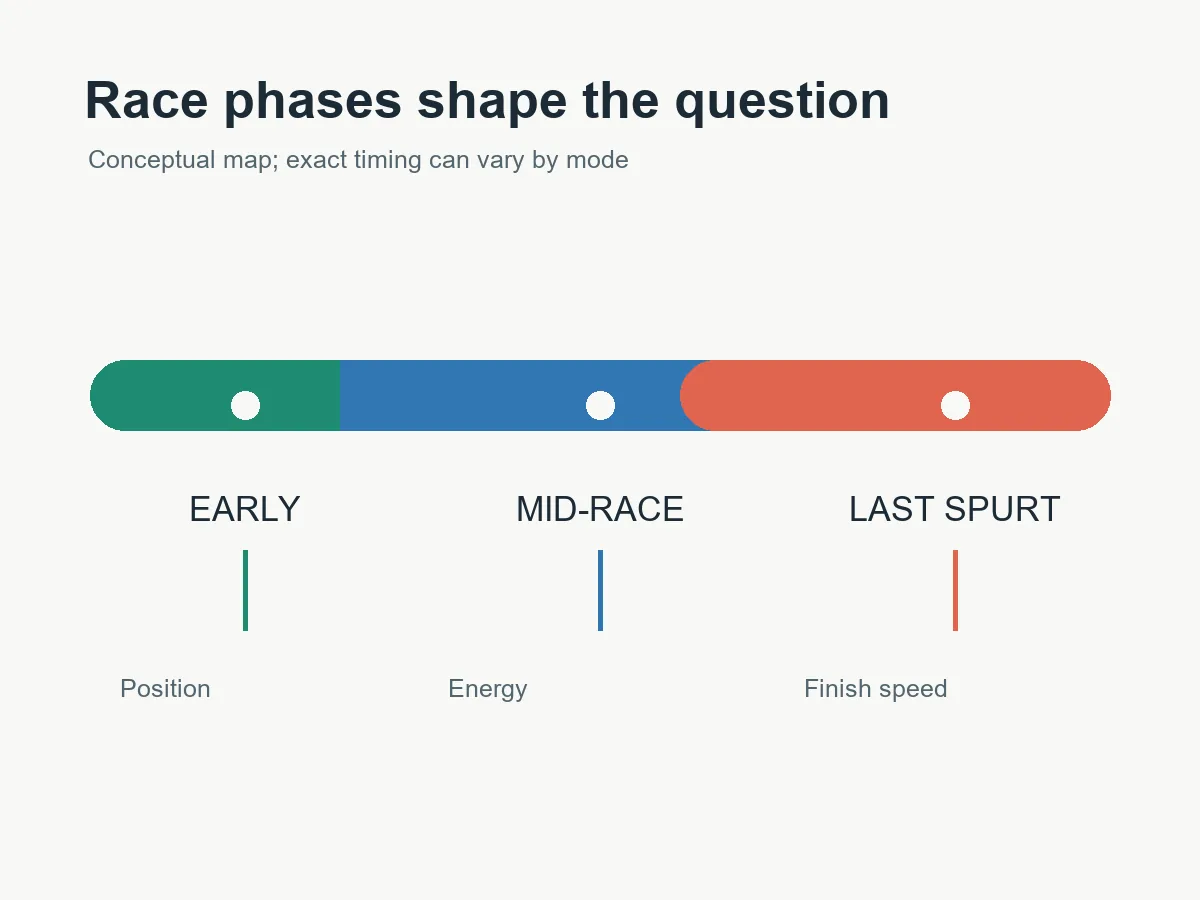
Umamusume stats can matter for different reasons as a race unfolds. Ask whether the runner struggled to settle into position, spent energy too quickly, lost ground on a climb, or lacked pace near the finish. The five stats do not share identical timing.
The illustration is a concept map, not a precise timeline. Course, distance, style, skills, and version can alter phase boundaries and interactions; verify the behavior in the current game or simulator.
Stats and aptitudes are different inputs
Aptitudes describe fit for a distance, surface, or running style; Umamusume stats are developed values used by the race model. A strong total cannot erase poor aptitude, and aptitude cannot supply missing energy or skills.
Another player's build may use different aptitudes, strategy, inherited skills, growth, cards, or version. Check those inputs before copying its stat line.
How to compare two builds fairly
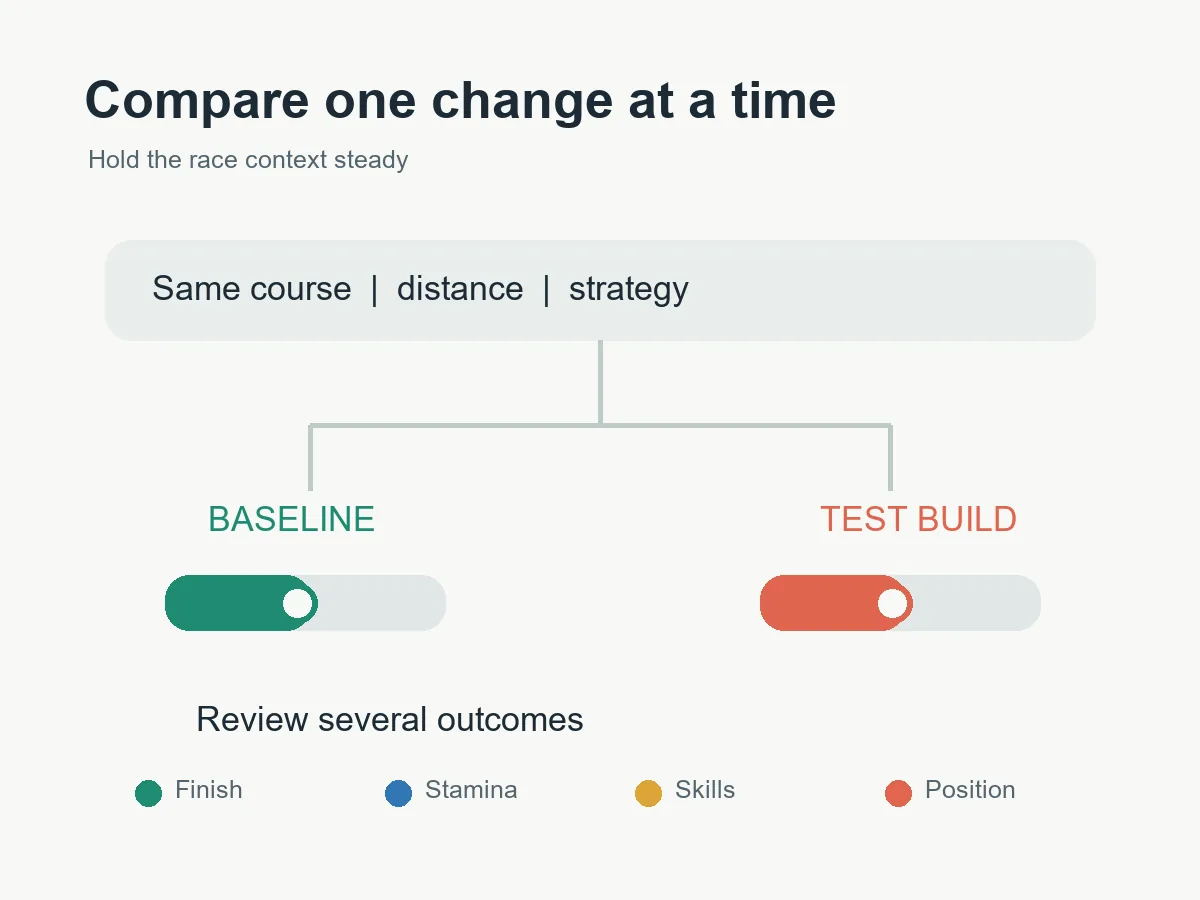
When comparing Umamusume stats, change one factor while keeping race context steady. If character, course, skills, and settings all change, you cannot tell which mattered. Record a baseline and compare more than final place.
Review finish, energy, skill activations, position, and timing. When runs vary, repeat both builds; one result does not prove that a small stat change always wins.
- Set the race. Use the same course, distance, and conditions.
- Lock the setup. Keep runner, aptitude, strategy, and skills unchanged.
- Change one factor. Adjust one stat and record the sheet change.
- Read the whole result. Compare energy, skills, position, and finish.
- Repeat. Look for a pattern across equivalent runs.
Two race-context examples
These Umamusume stats examples frame a test; they are not recommendations.
A runner fades before the finish
Check distance, pace, recovery, and energy before adding Speed. If stamina is the constraint, a higher speed ceiling may not help. Watch when performance falls in equivalent runs.
A runner cannot pass near the finish
Review position, style, Power, acceleration skills, and course space. Check skill conditions separately; one stat cannot fix traffic, timing, and eligibility at once.
Limits and common mistakes
For Umamusume stats, guides may describe different server versions, and simulator rules can lag behind updates. Treat formulas, thresholds, and priority rankings as versioned claims, not permanent facts.
Use a stats guide to choose a test. Make a controlled change and confirm the simulator models the mechanic. When sources disagree, avoid presenting a precise target as settled.
- Check aptitude, skill eligibility, and course fit.
- Priorities change with distance and running style.
- One finish is not a universal win-rate claim.
- Verify version-specific effects in current rules.
Common mistakes when reading stats
- Copying a fixed target. Race context and version change what a value means.
- Treating every guide as current. Check its server and version, especially for Guts and Power.
- Blaming Wit for every failed skill. Check eligibility before the activation roll.
- Changing several stats at once. Isolate one change to learn what affected the result.
Related Umamusume guides and tools
Use the mechanics explanation as a starting point, then follow the page that matches the next decision:
- Umamusume Training Guide - for turn choices, support cards, inheritance, and race preparation
- Umamusume Stamina Calculator - for checking energy assumptions against a target race
- Umamusume Rating Calculator - for estimating a build's rating from its stats and skills
- Skill Activation Guide - for separating eligibility conditions from activation behavior
Sources and image note
The mechanics summary cross-checks community guides that can differ by game version. This article avoids universal numeric thresholds where the sources do not establish one. The three visuals are original editorial concepts, not official game screenshots.
- Uma Guide: Stats - Community reference for the five stats, race-phase roles, Wit, and aptitudes.
- Game8: Stats Explained - Community guide covering stat descriptions, aptitudes, and version context.
- Umamusume Wiki: Stat Training - Includes a caveat that some descriptions reflect older JP mechanics and that Guts and Power have changed.
Umamusume stats FAQ
What does Speed do in Umamusume?
Speed contributes to attainable pace. Its phase-specific formula differs across guides and versions, so avoid assuming one universal rule.
How are Stamina and Guts different?
Stamina is the main energy reserve. Guts is associated with late-race situations such as the last spurt or duels; exact effects vary by version.
Does Power help a runner overtake?
Power is linked to acceleration and may help on hills or in traffic. Passing also depends on position, course space, skills, and race flow.
Does Wit guarantee skill activation?
No. A skill must meet its eligibility conditions, and Wit-related checks do not remove distance, style, position, or timing requirements.
Is there one best stat priority?
No. Priority depends on race, aptitudes, style, skills, resources, version, and the build's limiting factor.