Umamusume Champions Meeting Guide: Rounds, Teams, and Race Prep
Learn how Champions Meeting works, how to build a three-runner roster for a fixed course, and how to validate your plan before registration closes.


Quick answer: Champions Meeting is a course-specific PvP event where you register three trainees, race through qualifying rounds, and advance toward a final. The safest preparation order is course conditions first, team roles second, stamina and acceleration checks third, then repeated simulations instead of copying a generic tier list.
What Is Champions Meeting in Umamusume?
Champions Meeting is a recurring competitive event built around one announced race course. Everyone prepares for the same distance, surface, direction, season, weather, and track condition, so small course-specific choices matter more than general account power. A trainee who dominates Team Trials can underperform when her acceleration, stamina, or running-style plan does not match the event course.
You enter a roster of three trainees. The goal is not simply to place all three as high as possible in every heat. Your roster should create multiple ways to win while avoiding internal conflicts such as three runners competing for the same pace position, identical late acceleration plans, or insufficient front presence against common opponent lineups.
Event rules, dates, grade limits, and rewards can vary between releases and regional versions. Use this guide as a planning framework, then verify the current in-game notice before spending resources or registering your final roster.
Fixed course
Build for the announced distance, surface, direction, season, weather, and track condition rather than a universal meta.
Three-runner roster
Give each trainee a clear win condition and make the three plans complement one another.
Repeated races
Judge consistency across many simulations; one lucky result is not enough evidence for a final slot.
League Choice, Qualifying Rounds, and the Final
Champions Meeting normally separates entry conditions, qualifying progression, and a final. Exact labels and thresholds can change, but the preparation logic stays consistent: choose the league you can support, secure enough wins to advance, and preserve a reliable roster for the final stage.
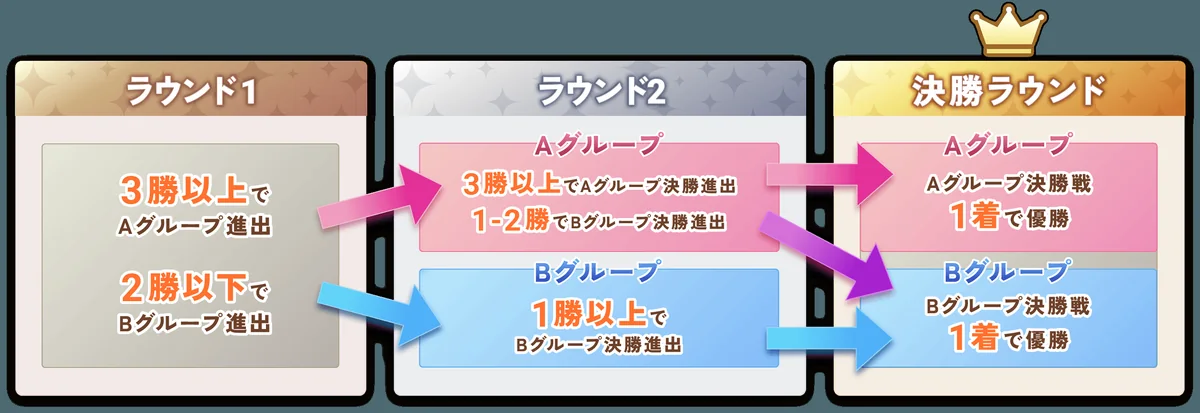
Choose the appropriate league
Select the entry bracket that matches your trainees and the event's current grade restrictions. A higher bracket is not automatically better if your roster cannot meet its consistency demands.
Advance through qualifying
Qualifying rewards repeatable win plans. Track how often each trainee wins, why losses happen, and whether one runner is carrying the entire roster.
Prepare for the final
The final is a smaller sample with more variance. Favor stable course fit, legal stamina margins, reliable acceleration, and several viable matchup paths.
| Stage | What matters | Preparation question |
|---|---|---|
| Registration | Eligibility and roster lock | Are all three trainees legal, fully equipped, and built for the exact announced course? |
| Qualifying | Repeatable wins across varied opponents | Does the team still win when the preferred runner gets a poor start or crowded position? |
| Final | Consistency under high variance | Do you have more than one realistic winning line instead of a single fragile high-roll plan? |
How to Build a Three-Runner Champions Meeting Team
Start with the course, not with a character tier list. Write down distance, surface, track direction, season, weather, lane condition, major corners, final straight length, and where valid acceleration windows occur. Those facts define which aptitudes, inheritance factors, recovery skills, and unique skills are actually useful.
Next, assign a role to each roster slot. A balanced roster may use a pace setter, a primary closer, and a flexible second win condition. Another event may reward two similar styles plus one disruptor. The correct answer depends on the course and likely field composition, not on a fixed 1-2-3 template.
Finally, test the team as a unit. A trainee can have an excellent individual win rate while reducing a teammate's access to position, pace, or skill triggers. Compare both individual win share and total roster win rate before deciding which build is better.
| Roster role | Primary job | Build emphasis | What to test |
|---|---|---|---|
| Pace setter | Control the front or create a useful race pace | Start consistency, speed profile, valid acceleration | Can she secure position without consuming too much stamina or helping opponents more than teammates? |
| Primary win condition | Convert the planned course section into a lead | Core stats, course skills, acceleration timing | Does the build win under normal races, not only perfect skill chains? |
| Secondary win condition | Cover bad matchups or a different race shape | Alternative style, stable positioning, complementary skills | Does this runner add real winning paths rather than duplicate the first build? |
A Practical Champions Meeting Simulation Workflow
Simulation is most useful when it answers one controlled question at a time. Keep the course and opponent assumptions stable, change one build variable, and record enough races to separate a repeatable improvement from random variance.
- Lock the course assumptions. Match the announced distance, surface, direction, season, weather, condition, and field assumptions before comparing trainees.
- Create a baseline roster. Enter the current three builds and record team win rate, individual win share, common loss patterns, and stamina failures.
- Change one variable. Test one recovery skill, one acceleration choice, one inheritance package, or one stat tradeoff instead of rebuilding everything at once.
- Run enough repetitions. Small samples exaggerate lucky starts and rare trigger chains. Use repeated batches and compare trends, not a single screenshot.
- Stress-test matchups. Include front-heavy, closer-heavy, high-stamina, and disruptive opponent sets that resemble the expected event field.
- Keep a decision log. Record why a version won or lost so later training results can be compared against the same acceptance criteria.
Use the Uma Race Planner, Stamina Calculator, Skill Tier List Guide to organize course assumptions, check endurance risk, and review skill roles before the final simulation pass.
Race Conditions That Can Change the Entire Build
Champions Meeting guides become outdated quickly when they ignore the exact course. Re-check these variables for every event, even when the distance looks familiar.
- Distance and surface. Aptitude, stamina demand, speed distribution, and useful skills differ between sprint, mile, medium, long, turf, and dirt races.
- Track direction and geometry. Right- or left-handed tracks, corner placement, slopes, and the final straight affect where positioning and acceleration convert into speed.
- Season, weather, and condition. Green skills and passive bonuses only help when their activation requirements match the announced event.
- Running-style distribution. The number of front runners, pace chasers, late surgers, and end closers changes pace, congestion, and position requirements.
- Regional release differences. Global and Japanese versions may not share the same schedule or available trainees. Confirm the notice for the version you play.
Rewards, Titles, and a Realistic Goal
Champions Meeting rewards usually scale with progression and final placement, and the event can award currency, items, and commemorative titles. The exact package changes, so treat the current event notice as the source of truth instead of relying on an old reward table.
Set a goal based on account maturity. A new account may gain more from building three legal, course-appropriate trainees than from chasing one expensive theoretical best build. A developed account can focus on matchup coverage, consistency, and marginal skill improvements.
Common Champions Meeting Preparation Mistakes
- Copying a generic tier list. A ranking without the event course, available supports, inheritance, and regional roster cannot decide your final team.
- Testing only one opponent lineup. A build that farms one matchup may collapse against a different running-style distribution.
- Ignoring team interaction. Three individually strong trainees can block one another's positioning or depend on the same race shape.
- Using too small a sample. One winning batch can be driven by starts, blocks, and rare skill timing rather than a real improvement.
- Building before reading the notice. Confirm the actual course, rules, dates, and entry restrictions before committing scarce resources.
- Treating stamina as a single target number. Recovery timing, pace, debuffs, track condition, and running style all affect whether the margin is safe.
Umamusume Champions Meeting FAQ
How many trainees do I need for Champions Meeting?
Prepare three eligible trainees for the event roster. Give each one a clear course-specific role and test how the three builds interact, not only how they perform individually.
Should I choose the highest Champions Meeting league?
Choose the bracket that matches the current event rules and the quality of your legal roster. A higher bracket can offer stronger rewards, but an inconsistent team may progress less reliably.
What stats matter most in Champions Meeting?
There is no universal priority. Distance, surface, running style, track geometry, stamina demand, and acceleration windows decide the useful balance. Start from the announced course and validate the final distribution in simulations.
Is a Champions Meeting tier list enough to build my team?
No. Tier lists can identify candidates, but they usually assume specific supports, inheritance, skills, course conditions, and available characters. Use them as a shortlist, then test account-fit builds.
How many simulations should I run?
Run repeated batches large enough to reveal stable trends and common loss patterns. The exact number depends on the simulator and test design, but one or two races are never enough to judge consistency.
Where should I check the current Champions Meeting schedule and rules?
Use the in-game event notice for your regional version. Official web pages explain the general race-event format, but dates, courses, eligibility, and rewards can change.
Build for the Course, Then Prove the Team
A strong Umamusume Champions Meeting plan begins with the official course conditions and ends with evidence from repeated races. Pick three complementary win conditions, keep enough stamina margin for realistic matchups, and prioritize acceleration that can activate in the actual course window.
Use rankings and community examples as starting points, not final answers. Your support cards, inheritance options, available trainees, and regional version determine which plan is practical. Confirm the current event notice, simulate the shortlist, and register the roster that wins consistently rather than the roster with the most impressive single result.
Official Sources and Further Reading
These links support the general event structure and provide current game context. The in-game notice remains the final source for the event you are entering.
- Official Umamusume Race Event page — General Champions Meeting format and official event artwork.
- Umamusume Pretty Derby official website — Official game news and current Japanese-version information.
- Umamusume official English website — Official global-version news and regional announcements.