継承ガイド 約13分 2026年6月18日

ウマ娘 継承ガイド:育成前に強い親を選ぶ方法 ウマ娘 継承ガイド

因子、継承親、相性、因子周回をレース目標から逆算するための実践ガイドです。

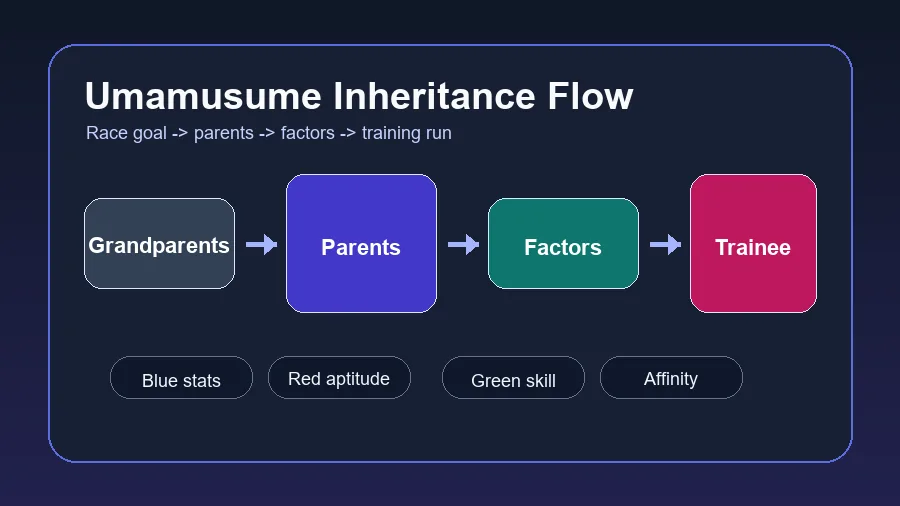
要点: ウマ娘の継承は、親と祖父母の因子を新しい育成へ渡す準備システムです。まず目標レースを決め、必要な青因子、距離やバ場の赤因子、使える緑因子、相性の良い親を選びます。星の総数だけで親を選ばず、弱い枠を一つずつ更新するのが効率的です。

育成前の継承はどう機能するか

Inheritance, often called legacy inheritance by Global players, is the setup step before training begins. You choose two parents, and each parent brings their own factors plus factors from their parents. Those inherited traits can raise starting stats, improve aptitude, unlock skill hints, and make a build realistic before the first training turn.

The important point is that inheritance is not a separate minigame from racing. It decides whether your training run has the right starting shape for a target race. A sprint build may want different red factors from a long-distance build, and a PvP build may value a specific unique skill more than raw stat stars.

Think of inheritance as a filter. You are not trying to collect every good factor in one family tree. You are trying to build a parent pair that solves the race goal you actually plan to test. Once that goal is clear, parent finder and legacy search tools become much easier to use.

Start with the race goal

Write down distance, surface, running style, key skill family, and the stat that is hardest for your deck to reach. Those five choices decide which inheritance factors matter.


Factor Types: What to Prioritize and When

Factor names differ slightly between communities, but most inheritance decisions can be grouped into four practical buckets. Use this table to decide what you are searching for before opening a parent finder. legacy search を開く前に、必須条件と妥協できる条件を分けておきます。距離適性が足りないレースなら、少し高い青因子より必要な赤因子を優先する場面があります。 似た親候補が並んだときは、その親で完成する育成像を比べます。星数が少なくても、デッキの弱点を補い、余計なターンを減らせる親の方が実戦的です。

Factor type What it affects Best use Planning note
Blue stat factors Starting stat boosts such as Speed, Stamina, Power, Guts, or Wit Fix the stat your support deck struggles to finish A useful blue factor on the right stat is usually better than a prettier but irrelevant star count.
Red aptitude factors Distance, surface, or running-style aptitude Raise a key aptitude toward A or S when the target race demands it Red factors are often the reason a parent is chosen even when the stat factors are not perfect.
Green unique factors Inherited versions of character unique skills Add a race-relevant acceleration, recovery, or positioning option Check timing and race fit. A famous unique skill can still be wrong for the target course.
White skill/event factors Extra skill hints, scenario traits, or race-related bonuses Round out the build after the core parent goal is solved Treat white factors as tie-breakers unless a specific skill is required for the plan.

The strongest parent is the one that supports the target build. For example, long-distance training may accept lower Speed inheritance if Stamina and distance aptitude are the real blockers.


How to Choose Parents Without Chasing Random Stars

A good parent pair has a job. One parent might provide the red distance factor and a useful unique skill, while the other covers a blue stat weakness and stronger compatibility. The grandparents matter because their factors can also appear in inheritance checks, so avoid judging only the two visible parent cards.

Compatibility, sometimes discussed as affinity or lineage affinity, is the part players often underestimate. Better compatibility does not guarantee a perfect inheritance result, but it improves the quality of the attempt and makes repeated farming less wasteful. When two candidate parent pairs look similar, choose the one with better race-role fit and cleaner lineage.

両親が同じ問題だけを解決していないかも確認しましょう。見た目は強くても、足りない適性やスタミナを誰も補っていないなら、育成結果は安定しません。

初心者は、まず必須の赤因子、次に足りない青因子、最後に白因子や相性の細かい改善を見る順番にすると迷いにくくなります。

Target race fit

Match distance, surface, and strategy first. A parent that helps the actual course is better than a generic high-star legacy.

Deck weakness coverage

Use inheritance to support the stat your support cards cannot reliably finish, such as Stamina for long races or Power for position fights.

Useful unique timing

Inherited unique skills should activate where the race needs them. Late acceleration and recovery timing are not interchangeable.

Grandparent quality

Check the full legacy chain. Grandparents can carry important red, blue, and white factors that make the pair worth farming.


A Repeatable Inheritance Farming Workflow

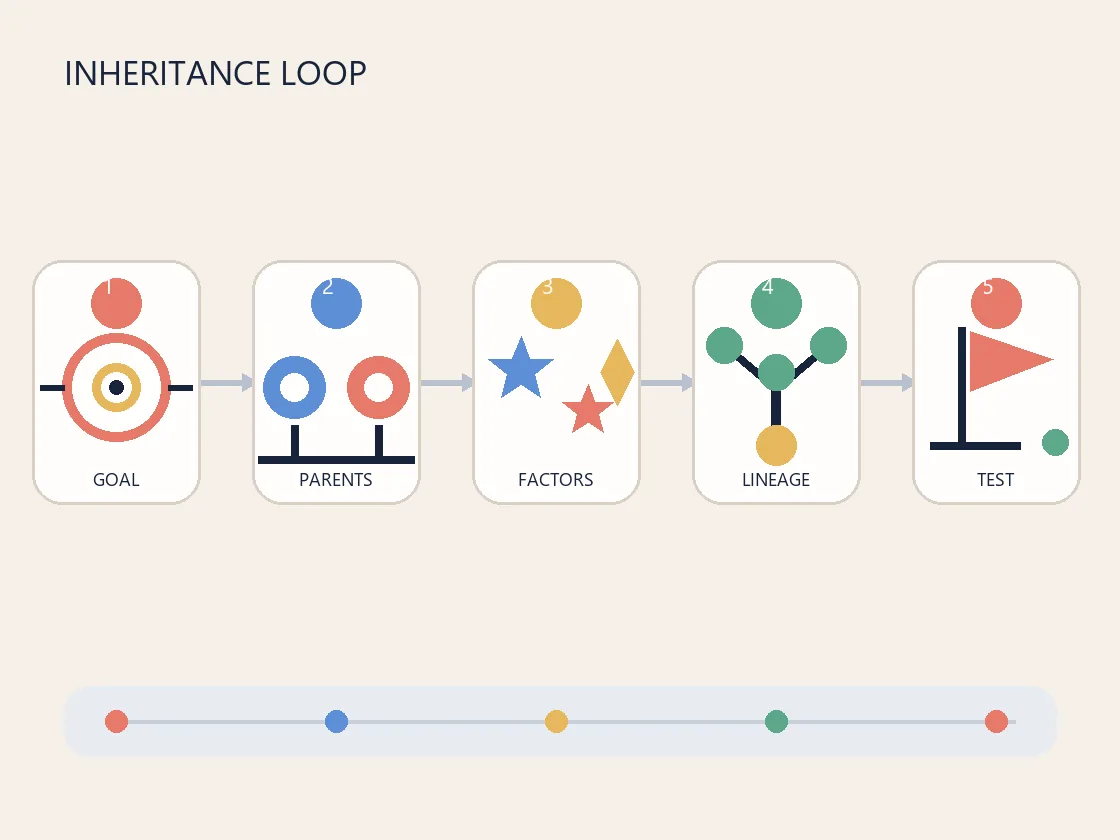
Inheritance farming is easier when you improve one slot at a time. Use this loop instead of rebuilding the entire family tree after every unlucky result.

1

Define the finished trainee

Pick the target race, distance, surface, strategy, minimum stamina, and must-have skill family before searching for parents.

2

Choose the first stable parent

Lock one parent that already solves a major requirement, such as distance aptitude or a useful inherited unique.

3

Farm the flexible parent slot

Use training runs to improve the second parent around the missing factor, not around every possible improvement at once.

4

Check grandparents before replacing a parent

A parent with weaker visible factors may still be better if the grandparent chain supports the exact race plan.

5

Test the result in training and racing

After the inherited setup creates a viable trainee, use training planning and race simulation to see whether the build actually performs.


Use Legacy Search, Parent Finder, and Race Tools Together

Search tools are most useful when you give them a narrow target. Instead of searching for the best Umamusume parent in general, search for the parent who solves a specific issue: mile aptitude, long-distance stamina, a late acceleration unique, or a stat your support cards cannot finish.

After you find a candidate pair, run a real training attempt and test the finished build. Inheritance only creates the starting opportunity; training decisions, support card events, stamina, and race conditions decide whether the final runner works.

各試行では、使った親、狙った因子、継承結果、シミュレーションで出た弱点を短く記録します。次の周回で何を直すべきか明確になります。

終盤で負け続ける場合、すぐスピード不足と決めつけないでください。スタミナ、回復、継承加速、パワー、脚質の位置取りを分けて確認します。

  1. Search for the exact red factor needed for the target race.
  2. Filter candidates by useful blue stat factors instead of total stars alone.
  3. Compare compatibility or lineage affinity before choosing between similar parents.
  4. Use a planner to schedule race requirements and avoid wasting training turns.
  5. Test the finished stats with stamina and race simulation tools before farming the next parent.

Useful internal tools for the inheritance-to-race workflow: Uma Race Planner, Stamina Calculator, Training Simulator Guide.


Common Inheritance Mistakes

Most bad parent choices come from optimizing the family tree without a race goal. Watch for these traps:

  • Choosing the highest star total without checking fit. A parent with many stars can still be weak if the red factor, unique skill, or stat focus does not help the target race.
  • Ignoring grandparents. Grandparents influence the inherited pool, so a clean visible parent can hide a weak or irrelevant lineage.
  • Farming every factor at once. Trying to improve blue, red, green, and white factors together makes progress hard to measure. Improve the weakest slot first.
  • Treating inherited skills as automatic wins. Skill timing, strategy, course phase, and activation conditions still matter. Test the final build instead of trusting the name.

Useful References for Legacy and Factor Planning

Use these sources for official game context and community data lookup. They complement your parent search and local simulation tests.


FAQ

What does inheritance do in Umamusume?

Inheritance passes factors from parents and grandparents into a new trainee. It can improve starting stats, aptitude, skill options, and the overall shape of a training run.

Are blue factors or red factors more important?

It depends on the race goal. Blue factors help stats, while red factors can solve distance, surface, or strategy aptitude. For many target races, the correct red factor is the harder requirement.

What is a parent finder used for?

A parent finder or legacy search tool helps locate parent candidates with the factors, compatibility, and lineage you need. It works best when your search target is specific.

Should I farm parents before every serious training run?

For casual runs, no. For competitive or difficult targets, a better parent pair can save many failed training attempts by improving the starting setup.

Do grandparents matter?

Yes. Grandparents contribute to the inheritance pool, so check the full family tree before deciding that a parent is good or bad.

Can inheritance replace race simulation?

No. Inheritance improves the starting plan. You still need to train the character and test stamina, skills, and race performance after the run.